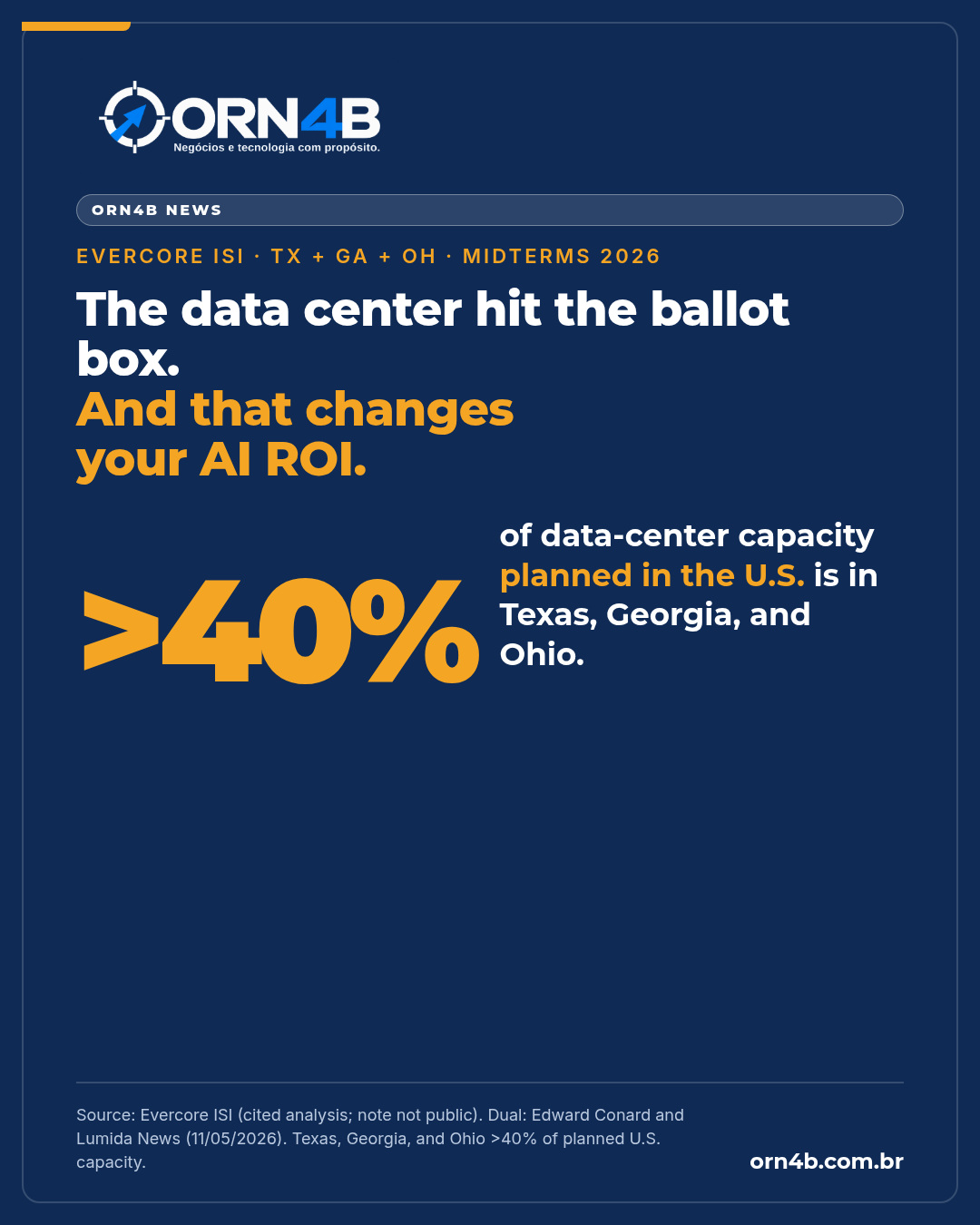
Texas, Georgia, and Ohio concentrate more than 40% of planned data-center capacity in the United States, according to an Evercore ISI analysis cited after the 2026 midterms (Edward Conard; Lumida News). That map includes projects such as Stargate (Texas), Camellia (Georgia), and Prometheus (Ohio).
Important caveat: the Evercore note is not a public PDF. The figure is attributed to Evercore ISI in a Wall Street Journal report, echoed by Edward Conard and Lumida News. The original note is not public. A nearby echo (Cleanview) points to about 40% of pending capacity in states whose governors pledged a pause, with slightly different framing.
The ballot changed the risk
In the same election, 56% of voters said AI data centers were a crucial or important factor in their vote for Congress (The Voter Poll by SSRS; n = 81,290; DCD). There were 41 local measures across 10 states (CNBC / Ballotpedia). In Texas, governor-elect Gina Hinojosa campaigned for a pause until new rules (Texas Tribune).
That does not cancel projects already licensed. It changes the timeline, the price, and the predictability of new capacity.
The Brazilian mirror
In Brazil, the Innova Assuntos Públicos study (via Valor / Times Brasil) mapped 16 state bills on data centers in 2026, versus 4 in 2025. 8 of 16 create restrictions or burdens (water, licensing, transparency). Ceará and Goiás have already passed attraction laws; São Paulo is debating reuse water; Rio Grande do Sul is debating EIA and a power cap (Times Brasil, 10/13/2026).
What this reveals (ORN4B reading)
This section is ORN4B's interpretation. When AI infrastructure becomes a ballot issue, the cloud and compute business case stops being purely technical. Leaders at companies and educational institutions need to:
Plan cost with a political buffer, not only with the provider's price list.
Choose use cases with measurable return, because contested capacity does not forgive a pilot without a metric.
Track water, energy, and licensing in Brazil, where state regulation is already moving.
The data center hit the ballot box. And that changes your AI ROI.
The ORN4B flow
AI alone is not the answer. At ORN4B, the path starts with leadership awareness, continues with team training and an assessment of what AI costs and delivers today, and only then moves to planning and implementation. Each stage is a module, contracted according to the maturity of each company or educational institution.
Let's talk
Want to review the cost and return of AI in your organization with this new risk on the map? Fill out the ORN4B contact form.
Get the next articles: join the ORN4B distribution list.