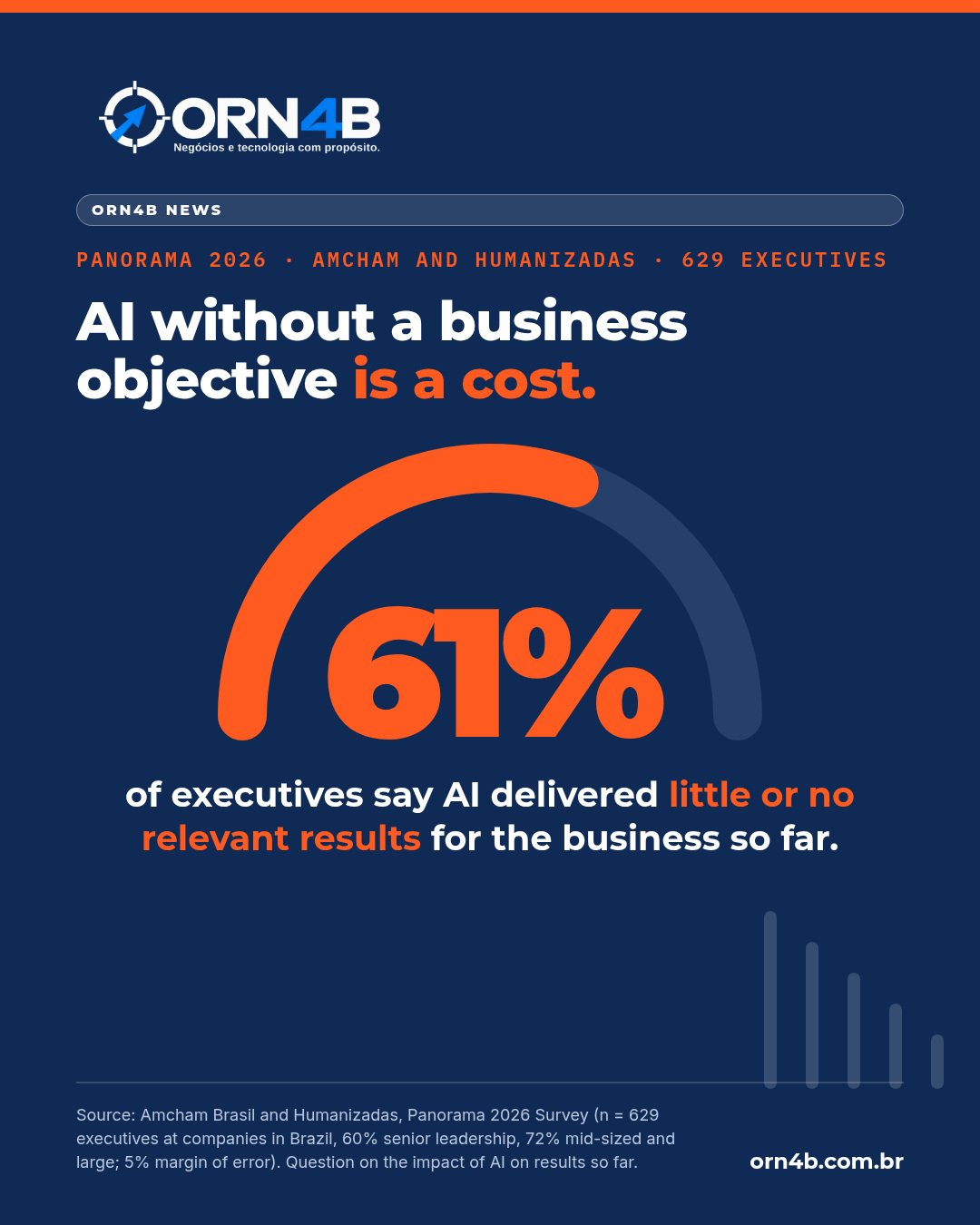
For 61% of the executives surveyed by Amcham Brasil and Humanizadas, artificial intelligence delivered little or no relevant business results so far. That breaks down into 34% who saw only "one-off results, with no effect on the business" and 27% who saw "no relevant results." Only 3% say AI generated new revenue and competitive advantage (Panorama 2026 Survey, Amcham and Humanizadas, PDF).
Who was surveyed: 629 executives at companies operating in Brazil, 60% of them in senior leadership roles and 72% at mid-sized and large companies that together employ about 592,000 people. The reported margin of error is 5%. The question covered the impact of AI use on company results (report, pp. 3 and 23; Diário do Comércio, 02/09/2026; Folha de Pernambuco).
What the president of Microsoft Brasil said
On the É Negócio program, a CNN Brasil and NeoFeed partnership aired on 10/26/2026, journalist Carlos Sambrana asked Priscyla Laham, president of Microsoft Brasil, where companies should start with AI. Her answer:
"Everything related to artificial intelligence should start with what the companies' business objectives are. So it effectively starts with the CEO and the leadership team defining what our business objectives are." (video, 18min40s: https://www.youtube.com/watch?v=IlLOgtRg1lQ&t=1120s)
"When it does not start that way, you will in fact spend a lot of money on artificial intelligence without necessarily getting the return." (video, 19min06s: https://www.youtube.com/watch?v=IlLOgtRg1lQ&t=1146s)
She also spoke about processes: "Reinventing processes, right? It is not putting agents on top of bad, old processes." (video, 4min00s)
What the survey shows
Impact of AI use on results, according to the 629 executives (report, p. 23):
3%: AI generated new revenue and competitive advantage;
8%: product and service innovation with visible impact;
28%: operational gains (efficiency, cost reduction);
34%: one-off results, with no effect on the business;
27%: no relevant results.
Other figures from the same study help explain why:
77% of companies invest nothing in AI or invest up to 2% of the budget (31% invest nothing and 46% invest up to 2%) (report, p. 21; Diário do Comércio);
43% point to a shortage of qualified professionals as the main limiter, and 41% cite a lack of integration across areas and systems (report, p. 26; Diário do Comércio).
The report itself concludes that "the challenge is not adopting AI, it is integrating it into strategy" (p. 30).
Not only in Brazil
In the IBM CEO Study 2025, which surveyed 2,000 CEOs across 33 countries between February and April 2025, only 25% of AI initiatives delivered the expected return in recent years, and 64% of CEOs admit that fear of falling behind leads them to invest in technologies before understanding the value they bring (IBM Newsroom, 05/06/2025; Inforchannel, 05/06/2025).
What this reveals (ORN4B reading)
This section is ORN4B's interpretation and not a conclusion of the surveys. When AI arrives without a clear business objective, it becomes a cost: licenses, pilots, and team hours that move no indicator. In practice, that usually shows up in three ways:
Tool before the objective: the company buys the solution and then looks for where to use it.
Old process with new AI: AI is placed on top of a bad process, and the result stays bad.
Nobody measures: without a before-and-after indicator, there is no way to know whether AI pays for itself.
The answer is not to stop investing. It is to start with the right question: which business objective will AI help achieve, and how will we measure it.
The ORN4B flow
AI alone is not the answer. At ORN4B, we work with a modular flow that each company or educational institution contracts according to its maturity:
Awareness (talk): leadership defines business objectives before the tool.
Training (enablement): teams learn to use AI with judgment and security.
Assessment (diagnosis): we map where AI is already used, what it costs, and what it delivers today.
Planning (strategy): priorities, budget, governance, and outcome indicators.
Implementation (execution): AI is rolled out in stages, measuring cost and return.
Let's talk
Want to know what AI costs and what it delivers today in your company or educational institution? Fill out the ORN4B contact form and we will talk about where to begin.
Get the next articles: join the ORN4B distribution list and receive each new piece by email or WhatsApp.
Sources
- Amcham Brasil and Humanizadas, Panorama 2026 Survey (original report, PDF; n = 629 executives, 5% margin of error): sample p. 3; investment 31%/46%/77% p. 21; impact 3%/8%/28%/34%/27%/61% p. 23; limiters 43%/41% p. 26; conclusions p. 30
- Diário do Comércio, "IA lidera agenda de 2026, mas investimento ainda é limitado" (02/09/2026; 629, 61%, 77%, 43%, 41%)
- Folha de Pernambuco, "Empresas adotam IA, mas falham em obter resultados, diz pesquisa da Amcham" (629, 61%, 3%, 77%, 43%, 84%)
- IBM Newsroom, "IBM Study: CEOs Double Down on AI While Navigating Enterprise Hurdles" (05/06/2025; 2,000 CEOs, 25%, 64%)
- Inforchannel, "CEOs dobram a aposta na IA mesmo enfrentando obstáculos, diz estudo da IBM" (05/06/2025; 25%, 64%)
- CNN Brasil, É Negócio with Priscyla Laham, president of Microsoft Brasil (video, aired 10/26/2026; quotes at 4min00s, 18min40s and 19min06s)
- CNN Brasil, "Avanço da IA exige preparo para novas funções, diz especialista" (10/23/2026, interview teaser)
- O Universo da TV, "CEO da Microsoft Brasil analisa impactos da inteligência artificial no mercado de trabalho no 'É Negócio'" (air date and time)